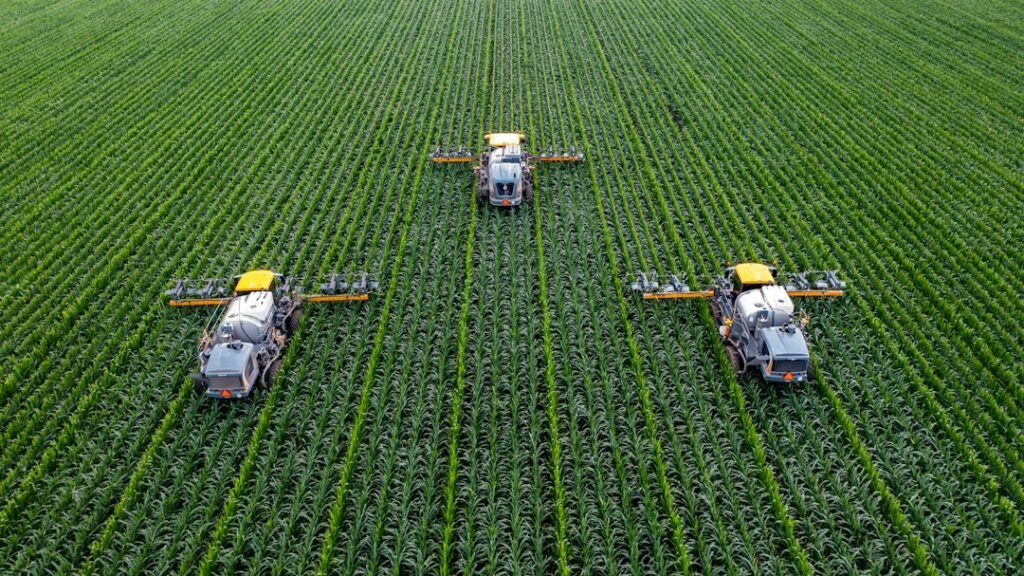
Running cables to every measurement point is expensive, slow and sometimes impossible. A LoRaWAN sensor network solves this by connecting battery-powered sensors wirelessly over long distances. It is a practical way to monitor temperature, humidity, levels, energy and soil conditions across a factory site or a farm.
This article explains how LoRaWAN works, where it fits and how to plan a deployment.
What Is LoRaWAN?
LoRa is a radio modulation technique based on chirp spread spectrum. It allows small data packets to travel long distances using very little power. LoRaWAN is the network protocol built on top of LoRa, maintained by the LoRa Alliance.
LoRaWAN operates in unlicensed sub-GHz frequency bands, such as EU868 in Europe and many other regions, and US915 in North America. Always use devices configured for the regional band that applies in your country.
Key characteristics
- Long range: typically several kilometres in open rural areas, and shorter in dense buildings.
- Low power: sensors can run on batteries for years, depending on how often they transmit.
- Low data rate: designed for small messages such as a temperature reading, not for video or large files.
- Good penetration: sub-GHz signals pass through walls and vegetation better than higher-frequency signals.
How a LoRaWAN Network Is Built
A LoRaWAN system uses a star-of-stars architecture with four main parts:
- End devices (sensors): measure and transmit data.
- Gateways: receive radio messages from any sensor in range and forward them over Ethernet, Wi-Fi or cellular.
- Network server: manages devices, removes duplicate messages and handles security.
- Application server: decodes the data and delivers it to dashboards, databases or control systems.
Sensors are not paired to a single gateway. Any gateway in range can receive a message, which adds redundancy.
Security
LoRaWAN uses AES-128 encryption with separate network and application session keys. Devices join the network through Over-The-Air Activation (OTAA), which is generally recommended, or Activation By Personalisation (ABP).
Device classes
- Class A: lowest power. The device transmits, then briefly listens for a reply. Used by most battery sensors.
- Class B: adds scheduled receive windows.
- Class C: listens almost continuously. Suited to mains-powered devices such as actuators.
LoRaWAN Compared with Other Wireless Options
| Technology | Range | Power use | Data rate | Infrastructure | Typical use |
|---|---|---|---|---|---|
| LoRaWAN | Long | Very low | Low | Own or public gateways | Distributed sensors |
| NB-IoT / LTE-M | Long | Low | Low to medium | Mobile operator network, SIM | Wide-area assets |
| Wi-Fi | Short | High | High | Access points | Cameras, high data |
| Zigbee / Bluetooth mesh | Short, extended by mesh | Low | Low to medium | Mesh nodes | Buildings, local automation |
| Wired RS485 / 4-20 mA | Cable length | Powered | Varies | Cabling | Critical control |
LoRaWAN is strongest when you need many low-data sensors spread over a wide area, without a mobile subscription per device. It is not intended for real-time control loops or safety functions, where wired connections remain the right choice.
Applications in Factories
- Environmental monitoring: temperature and humidity in warehouses, clean rooms and cold stores.
- Energy metering: pulse counters and current sensors on sub-meters.
- Condition monitoring: wireless vibration and temperature sensors on motors and pumps.
- Tank and silo levels: ultrasonic or radar level sensors on remote storage.
- Leak and door sensors: simple alerts for water leaks or open doors.
- Air quality: CO₂, particulate and gas monitoring in work areas.
Because no cabling is required, sensors can be added to existing buildings with minimal disruption.
Applications on Farms
- Soil moisture and temperature: to schedule irrigation based on actual conditions.
- Weather stations: rainfall, wind, temperature and humidity on site.
- Water tanks and wells: level monitoring to avoid running dry.
- Greenhouses: temperature, humidity, light and CO₂ monitoring.
- Livestock buildings: ammonia, temperature and ventilation monitoring.
- Cold storage: temperature tracking for harvested produce.
The long range of LoRaWAN means a single well-placed gateway can often cover large areas of open farmland.
Planning a Deployment
- Define what to measure and how often. Reporting intervals directly affect battery life.
- Choose public or private network. A private gateway gives full control; a public or community network can reduce setup effort where coverage exists.
- Place gateways high, such as on a roof or mast, with a clear view of the area. Use an outdoor-rated antenna.
- Test coverage with a field tester or a sample device before installing all sensors.
- Pick the right enclosures, with an IP rating suited to dust, rain or washdown.
- Plan payload decoding so sensor data arrives correctly in your platform.
- Integrate the data with dashboards, alarms, or your SCADA or ERP system, often via MQTT or HTTP.
- Plan maintenance, including battery checks and firmware updates.
Common Pitfalls
- Transmitting too frequently, which drains batteries and can exceed duty-cycle limits.
- Placing gateways indoors or low, behind metal structures.
- Mixing devices configured for different regional frequency plans.
- Using LoRaWAN for tasks that need fast, guaranteed response.
Building Your LoRaWAN Sensor Network
A LoRaWAN sensor network brings long-range, low-power monitoring to places cables cannot easily reach. For factories it simplifies retrofits; for farms it turns large areas into measurable, manageable data.
Browse our IoT and wireless modules category to find LoRaWAN sensors and gateways, or contact our team for help planning coverage and choosing devices for your site.